
Why this question matters
This question recently came up during a discussion with a customer. The customer is currently running Oracle databases on premises and is planning a migration to Oracle Exadata Cloud@Customer (ExaCC).
In an on premises environment, we assume the customer already owns all the licenses required to run their databases in a compliant manner. However, an important question arises when moving to ExaCC: Are additional licenses required? What about encryption? Is RAC mandatory? And how does Active Data Guard fit into the picture?
These questions inspired me to collect the relevant information from Oracle documentation and share some answers that may be useful to others facing a similar migration.
Understanding the Exadata Cloud@Customer BYOL Model
Let’s find the answers by following the same approach I described in my previous article, What’s Really Included in the Oracle Database “License Included” Option in the Cloud? – Cloud Stories from the Field
As a starting point, open the Oracle PaaS and IaaS Universal Credits Service Descriptions.
Search for SKU B110663, which corresponds to Oracle Exadata Cloud@Customer Database ECPU – BYOL (ECPU Per Hour). Right away, you’ll find some important information.
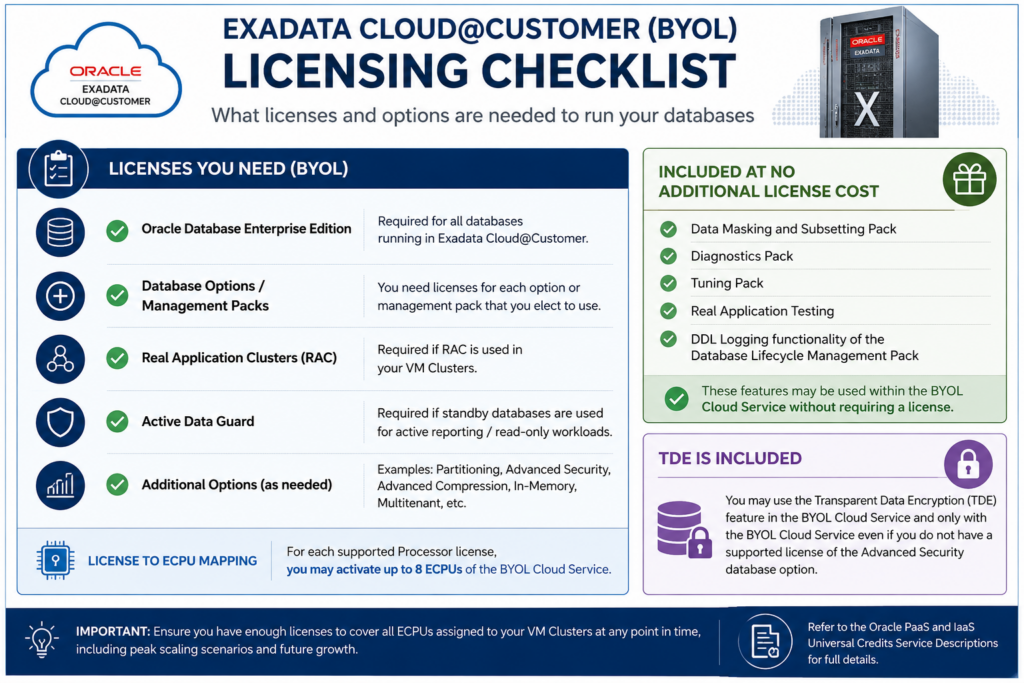
The first key statement is that You need:
“Oracle Database Enterprise Edition plus a license for each database option/management pack that you elect to run in your cloud environment.”
How Oracle Licenses Map to ECPUs
The document also explains how existing processor licenses map to ECPUs:
“For each supported Processor license, you may activate up to 8 ECPUs of the BYOL Cloud Service.”
In practical terms, this means that each eligible processor license you own can be used for up to eight ECPUs in ExaCC.
Therefore, you need enough Oracle Database Enterprise Edition licenses to cover all ECPUs that may be allocated across your VM Clusters, including potential peak capacity during scaling operations. In addition, you must have licenses for every database option you plan to use in your Exadata Cloud@Customer environment.
Which Database Options Require Licenses?
The document lists the following eligible options:
- Active Data Guard
- Advanced Analytics
- Advanced Compression
- Advanced Security
- Database In-Memory
- Database Lifecycle Management Pack
- Cloud Management Pack for Oracle Database
- Database Vault
- Label Security
- Multitenant
- OLAP
- Partitioning
- Real Application Clusters (RAC)
- Spatial and Graph
License Planning for VM Clusters
For example, if you intend to use Partitioning in a database running within a VM Cluster, you must have enough Partitioning licenses to cover both normal operation and any future scale up scenarios. This makes license aware VM Cluster planning extremely important.
Included Features That Do Not Require Additional Licenses
The service description also includes several valuable exceptions.
The following options may be used with the BYOL Cloud Service without requiring a supported license, provided they are used only within the BYOL Cloud Service:
- Data Masking and Subsetting Pack
- Diagnostics Pack
- Tuning Pack
- Real Application Testing
- DDL Logging functionality of the Database Lifecycle Management Pack
This means there is no need to own separate licenses for these features, which are particularly useful for security, monitoring, performance analysis, and comparing workloads between on-premises and cloud environments.
Transparent Data Encryption Is Included
Further down in the document, another important statement appears:
“You may use the Transparent Data Encryption feature in the BYOL Cloud Service and only with the BYOL Cloud Service even if you do not have a supported license of the Advanced Security database option.”
This is especially relevant because many organizations want to strengthen their security posture through data encryption but are concerned about additional licensing costs.
In Exadata Cloud@Customer, Transparent Data Encryption (TDE) is included at no additional cost.
RAC and Active Data Guard Licensing Considerations
Although the licensing rules can be complex, it is generally important to ensure that you have sufficient Real Application Clusters (RAC) licenses for the VM Clusters where RAC is being used.
There are scenarios where certain database deployments may not require RAC licensing, but that topic goes beyond the scope of this article and may deserve a dedicated blog post in the future.
Regarding Data Guard, standard Data Guard functionality is included with Oracle Database Enterprise Edition. However, if you plan to use the standby database for active reporting or read-only workloads, you will need an Active Data Guard license. Those licenses must also be included in the license pool allocated to your ExaCC deployment.
Key Takeaways
- You need sufficient Oracle Database Enterprise Edition licenses and option licenses to cover the ECPUs assigned to your VM Clusters at any point in time, including peak scaling scenarios.
- VM Cluster design should take licensing requirements into account, especially when different databases require different options.
- Several useful management and testing packs are included for use within the BYOL Cloud Service without additional licensing.
- Transparent Data Encryption (TDE) is included in the cloud and does not require an Advanced Security license.
- Active Data Guard licensing is required if standby databases are used for active reporting workloads.
- You can switch from a BYOL model to a License Included model whenever your business requirements change.
Final Thoughts
I hope this article helps clarify the licensing considerations for Oracle Exadata Cloud@Customer and supports your future migration planning.