This article has been updated because many things have changed rapidly in Oracle’s hyperscaler offerings. If you’d like to review the original version, I’ve kept it available to highlight the differences compared with today. You can find it here: “Obsolete – Your Guide to Oracle Multi-Cloud: How and Where to Track Service Availability” – Cloud Stories from the Field
However, these changes further highlight the need for a single source of truth where service availability can be tracked.
Over the past few months, a remarkable shift has become evident in conversations with Oracle customers and partners: the topic on everyone’s mind is Oracle’s multi-cloud strategy, especially the innovations around Oracle Database services delivered on Azure, AWS, and GCP.
At the recent launch event for Oracle Database@Azure in Switzerland, we welcomed more than 100 customers and partners. The official launch of Oracle Database@AWS attracted an even larger audience, with attendance more than doubling. This turnout speaks volumes about the excitement and momentum building around these solutions. Attendees shared their eagerness to modernize data estates while leveraging best-in-class cloud platforms of their choice.
Top Questions: When and What?
Across all these discussions, two main questions always arise:
- “When will these services be available in my country?”
- “Which Oracle Database offerings will I be able to use?”
- Which are the Oracle Multicloud Services in my region?
To answer these, Oracle provides a clear and up-to-date overview:
Oracle Multi-Cloud Capabilities and Regions
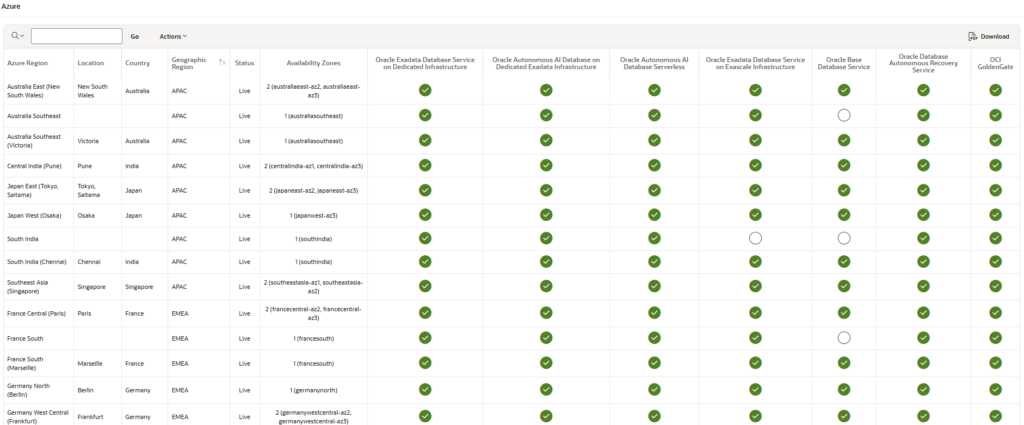
Service Differences Across Cloud Providers
A key point customers need to be aware of is that while Oracle Exadata Database Service on dedicated infrastructure and the Oracle Database Zero Data Loss Autonomous Recovery Service are foundational and available for every hyperscaler, the broader set of offerings differs depending on the provider:
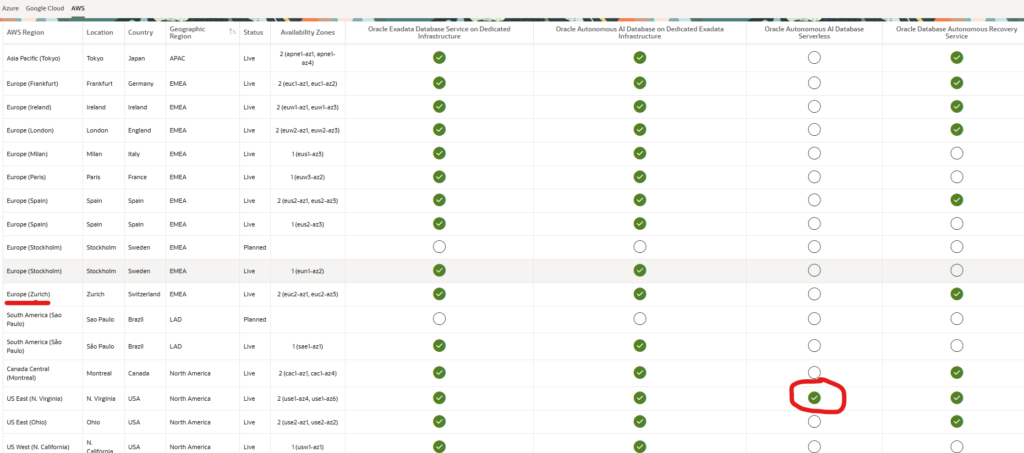
- AWS:
Currently, AWS offers Oracle Autonomous AI Database on Dedicated Infrastructure, Oracle Exadata Database Service, and Oracle Autonomous Recovery Service, and is also rolling out Oracle Autonomous AI Database Serverless, for example in US East. However, AWS is no longer the only hyperscaler delivering Autonomous Dedicated.
- Azure:
Azure offers a broader spectrum of managed Oracle Database services, including:- Oracle Base Database Service
- Oracle Exadata Database Service on Exascale
- Oracle Exadata Database Service on Dedicated Infrastructure
- OCI GoldenGate
- Oracle Autonomous AI Database Serverless
- And in the meantime also Autonomous AI Dedicated Service is available in different regions.
These offerings are evolving, and availability may change based on updates or regional expansion, so it’s always best to check the Multi-Cloud Capabilities page for the latest information.
Switzerland: What’s Available Right Now?
You want to know which Oracle Multicloud Services are available in Switzerland?
At this time, Oracle Database@Azure and Oracle Database@AWS are both available with different offerings
For the latest updates as new services and cloud providers become available in Switzerland, please refer to the Multi-Cloud Capabilities page
In Summary
The demand for Oracle’s multi-cloud offerings is stronger than ever, but the exact services and features depend on both the provider and the region. Keeping up-to-date with Oracle’s official resources ensures you have the latest information as new capabilities and regions come online.
Very interesting Paolo.
I think Exadata momentum is really accelerating.