This article is based on a presentation that my colleague, Soyhan Parlar, delivered at the Swiss Oracle User Group Day in Bern in March 2026, which we prepared together.
A New Opportunity for Autonomous Database
Oracle Autonomous Database was launched back in 2018. However, at least in Switzerland, adoption has not been as widespread as many of us expected. The technology itself is outstanding, and the idea of a self-managing database has always attracted significant interest from customers. The ability to empower developers, reduce the operational workload of database administrators, and free up valuable time for mission-critical projects has obvious benefits. Smaller companies without dedicated database administration teams quickly recognized the potential value as well.
Yet one concern consistently surfaced in customer discussions: Autonomous Database was available only on Oracle Cloud Infrastructure (OCI) or Exadata Cloud@Customer. Many organizations had already defined cloud strategies centered around other hyperscalers. Others were reluctant to onboard an additional cloud provider because of the associated effort, governance requirements, and operational overhead. Some simply needed a solution that integrated more naturally with their existing technology stack, which was often based on non-Oracle products.
With the introduction of Oracle Database@Azure, Oracle Database@AWS, and Oracle Database@Google Cloud, Autonomous Database can now run within the world’s leading hyperscaler environments. And what are we seeing? Autonomous Serverless is making a strong comeback.
Interestingly, the current level of interest is particularly high among smaller companies with relatively modest Oracle footprints. Organizations that were already considering cloud migration initiatives and data center exit strategies (and the associated cost savings should not be underestimated) now have a straightforward path to migrate their Oracle databases to their preferred hyperscaler.
Understanding Your Licensing Options
Customers can choose between two licensing models:
During customer discussions, another important—but often overlooked—aspect frequently emerges.
- License Included: No existing Oracle licenses are required. You simply subscribe to the service, and the database licenses are included in the price. There are no separate license contracts or support fees to manage.
- Bring Your Own License (BYOL): You continue using licenses you have already purchased, preserving your existing investment. In return, the cloud service cost is typically about 25% of the equivalent License Included option.
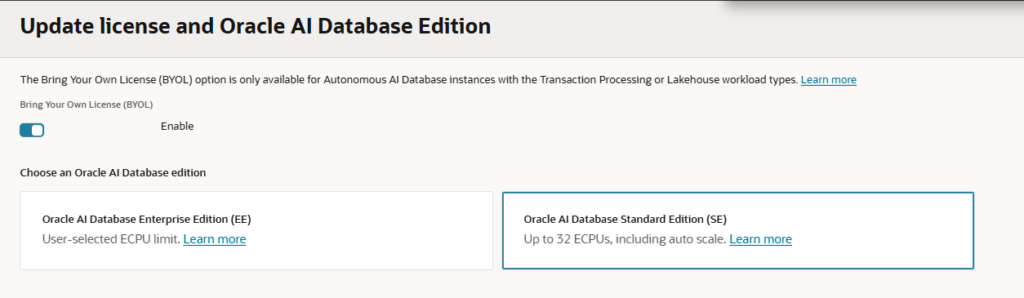
The interesting part is that Autonomous Database also supports Standard Edition licenses under the BYOL model.
According to Oracle’s PaaS and IaaS Universal Credits Service Descriptions, one Standard Edition Processor License can be mapped to up to 16 ECPUs, and an Autonomous Database instance can use up to 32 ECPUs when licensed with Standard Edition.
For more details, refer to:
- Oracle PaaS and IaaS Universal Credits Service Descriptions
- My previous blog article: What’s Really Included in the Oracle Database “License Included” Option in the Cloud? – Cloud Stories from the Field
The relevant section of the documentation states:
“If You run Oracle Database Standard Edition, Oracle Database Standard Edition One or Oracle Database Standard Edition 2, then Your BYOL requirements are as follows.
For each supported Processor License of Oracle Database Standard Edition Programs (where a Processor is defined as equivalent to an occupied socket), You may activate up to 16 BYOL ECPUs or 4 BYOL OCPUs of the Cloud Service.
Each Service instance may not exceed 32 ECPUs or 8 OCPUs, including auto scale ECPUs or OCPUs. The aggregate of all Cloud Service instances may exceed this limit.”
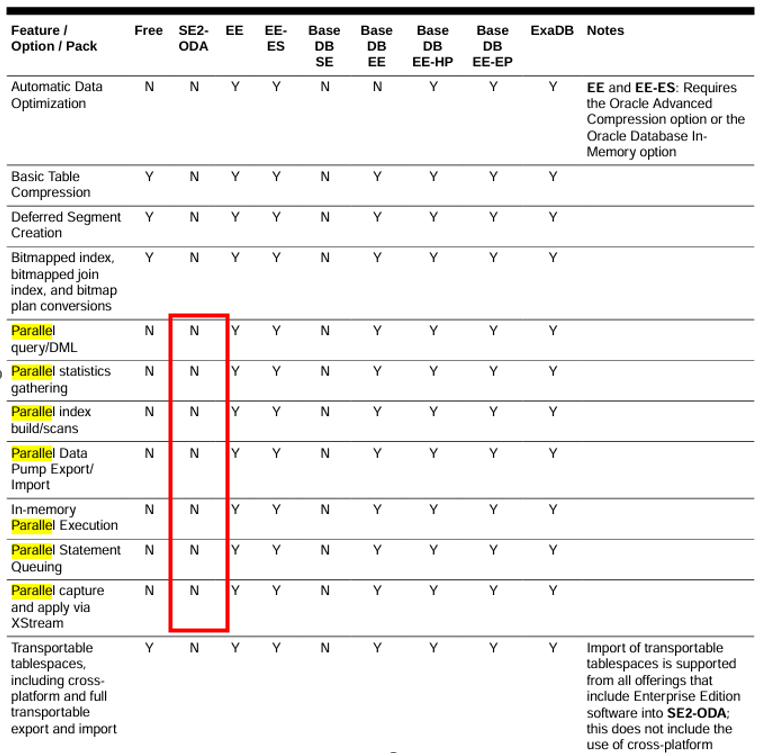
That is a considerable amount of compute capacity. Since four ECPUs generally correspond to approximately one physical CPU core, and Standard Edition databases do not support parallel query execution, most existing Standard Edition workloads will not require additional cores anyway (see the Database Licensing Information User Manual for details).
Enterprise Features and Exadata Technology out of the box
What makes this particularly interesting is that you can run a database with Enterprise Edition capabilities and Exadata technology while using Standard Edition licenses through Autonomous Database.
Autonomous Database runs on Exadata infrastructure, and many advanced capabilities are available out of the box. For example, features such as Data Guard can be used without introducing licensing compliance concerns.
In addition, Transparent Data Encryption (TDE) is included with Oracle Cloud databases at no additional cost. If you are considering improving your database security posture, Autonomous Database allows you to do so without purchasing separate Advanced Security licenses.
Assessing Your Migration Readiness with CPAT
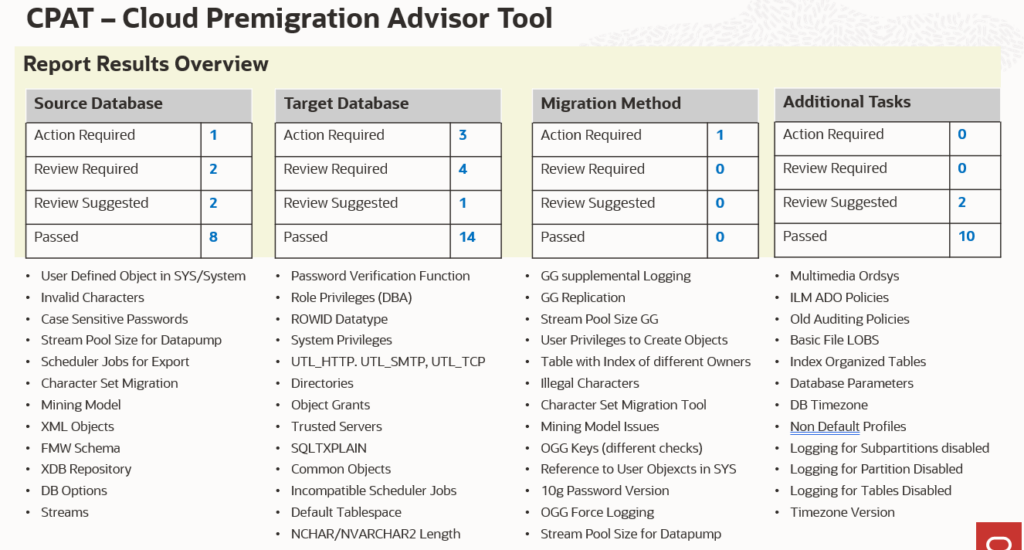
Of course, there are some differences between a traditional on-premises Oracle Database and an Autonomous Database deployment. If you are unsure whether your environment is a good candidate, reach out to your Oracle Sales Consultant. We can organize an assessment using the Cloud Premigration Advisor Tool (CPAT).
CPAT provides valuable information, including:
- Required changes before migration
- Recommended migration methods
- Compatibility considerations
- Potential issues to address after migration
Based on practical experience, approximately 95% of databases are suitable candidates for Autonomous Database migration, often requiring only minor adjustments such as updates to password verification functions.
Here is an example of what a CPAT report looks like:
You may also want to review the official documentation: Using the Cloud Premigration Advisor Tool
My Opinion
Give it a try.
Test the features and capabilities in your preferred cloud environment. Migrate a non-critical database and see how the process works in practice.
You may be surprised by how straightforward it is. In many cases, migrating to Autonomous Database is significantly easier than migrating to a different relational database platform altogether.
And once you experience Enterprise Edition functionality and Exadata performance running behind the scenes while leveraging your existing Standard Edition licenses, you may discover a very compelling modernization path for your Oracle estate.